
The 5 Washing Machine Faults We See Most in Islamabad Homes

A washing machine rarely fails without warning. It drains a little slower than usual, it leaves a small puddle by the door, it stops halfway through a spin, or it starts making a sound it never made before. Those small signs are easy to ignore for a week or two, until a load is left sitting in water or the machine stops altogether. Knowing what to look for helps you describe the problem clearly when you call.
Across the front-load and top-load machines we service in Islamabad — Samsung, LG, Haier, Dawlance, Kenwood — five faults account for most service calls.
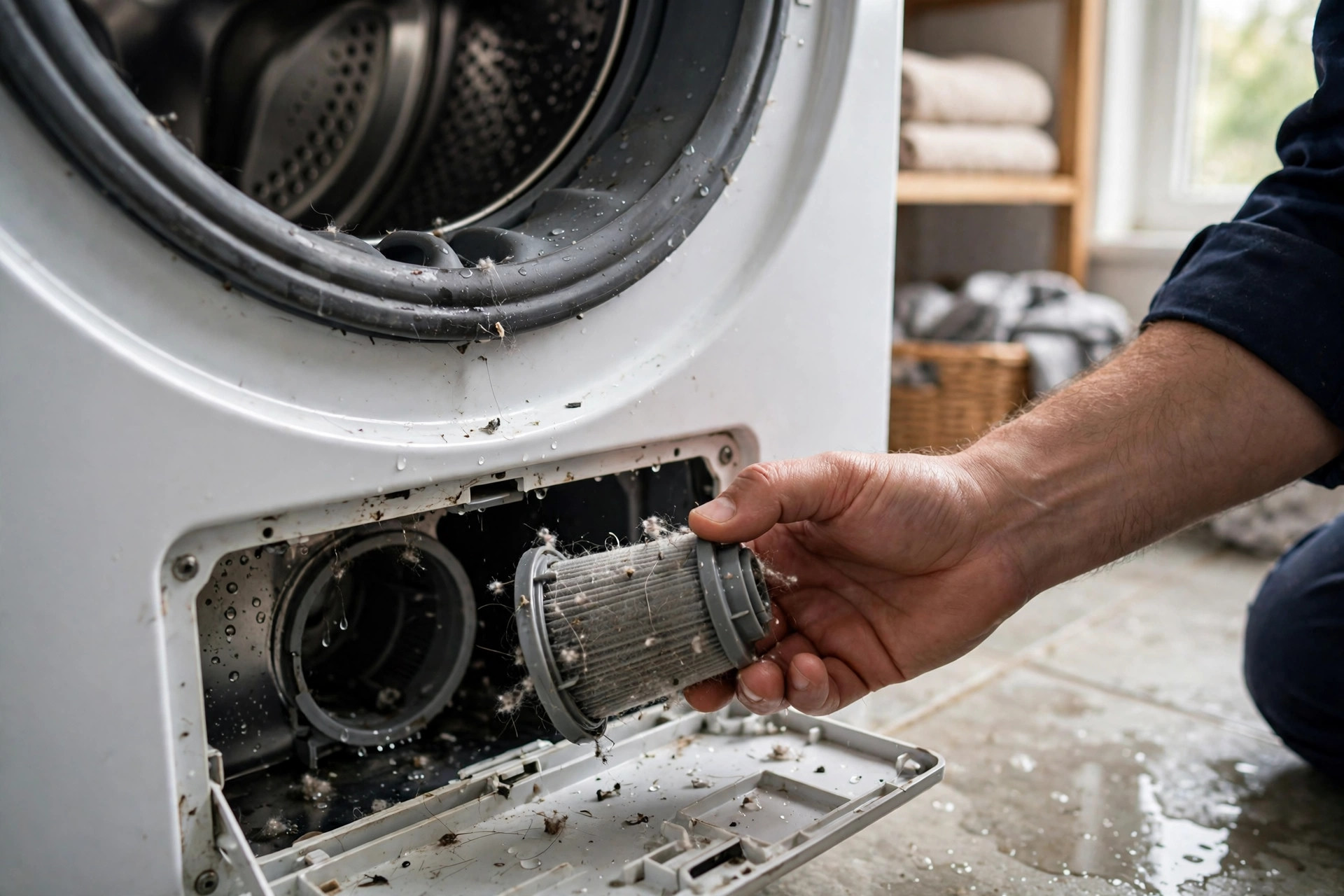
Drainage problems and door seal leaks
Drainage is the first place to look when water stays in the drum after a cycle. You may notice that the machine takes much longer to finish, that it stops with water still inside, or that clothes come out much wetter than usual. A small item, lint, or detergent residue can restrict the flow, and the pump itself can become blocked over time. Drainage failure is usually a blocked drain pump, resolved in one visit. During a visit, the pump and filter are checked and cleared, and the pump is tested to make sure it runs as it should. Keeping the filter clean and emptying pockets before a wash help reduce the chance of a blockage forming again.
A door seal leak is easy to spot once you know where to look. You may see water on the floor in front of a front-load machine, dampness along the bottom edge of the door, or a musty smell from the rubber seal. Over time the rubber can wear or crack so that it no longer sits tightly against the door. Door seal leaks on Samsung and LG front-load machines develop as the rubber gasket wears — a straightforward replacement. The fix involves fitting a new gasket that matches the model and running a short cycle to confirm there is no leak. Wiping the seal dry after use and leaving the door slightly open between washes help it last longer.
Spin faults, noise, and control panel problems
A spin fault can leave clothes soaking wet, or it can stop the cycle before the spin starts at all. On a top-load machine, the drum may not spin, it may spin only slowly, or it may stop and start without completing the cycle. Spin cycle faults on Haier top-load machines often point to a worn motor coupling or lid switch. The coupling connects the motor to the drum, and when it wears, the drum cannot turn as it should. The lid switch tells the machine that the lid is closed and it is safe to spin, and when it fails, the machine may refuse to spin. A visit covers checking both parts, along with the motor, so the exact cause is found before any part is replaced.
Unusual noise during spin is a warning sign worth taking seriously. You may hear grinding, rumbling, or knocking, or a loud sound that grows as the drum speeds up. A load that is unevenly spread in the drum can cause temporary noise, so it is worth redistributing the load and trying again, but a noise that returns on every spin points to a part inside the machine. Unusual noise during spin is frequently a worn drum bearing. The bearing supports the drum as it turns, and when it wears, the drum can move unevenly and make a loud sound at high speed. Continuing to use a machine with a worn bearing can put extra strain on other parts, so it is best to stop the machine and arrange a check.
Control panel faults can be confusing because the machine may look fine but will not respond as it should. Buttons may stop working, the display may show an error, the machine may not start a selected programme, or it may stop partway through a cycle. Control panel faults on Dawlance and Kenwood machines are typically a PCB issue. The PCB controls the programmes, the timing, and the signals to the motor, pump, and other parts. When it fails, the machine may not receive the right instructions, even though the drum, motor, and pump are still in working order. A diagnosis checks the panel, the wiring, and the board, so a simple connection problem is not mistaken for a board fault.
What a diagnosis visit covers and what repairs cost
A diagnosis visit is the step that comes before any repair, and it is meant to give you a clear answer rather than a guess. The visit covers checking the fault you described, running the machine through the relevant part of a cycle where it is safe to do so, and inspecting the pump, seal, coupling, lid switch, bearing, and control panel as needed. Simple causes are checked first, such as a blocked filter or a loose connection, so that a small problem is not treated as a major repair. Once the exact fault is identified, you can be told what the repair involves and which part is needed before any part is ordered.
| Service | Price |
|---|---|
| Diagnosis visit | From Rs 800 (waived on repair) |
| Drainage and motor repairs | Rs 1,500–4,000 |
In all five cases, a same-day diagnosis visit from Rs. 800 will identify the exact fault before any part is ordered.