
How Often Should You Deep-Clean Your Sofa?

Most households underestimate how much dust settles into upholstery — fabric, velvet, and chenille all trap more than they show.
A sofa is used every day, yet it is easy to forget how much it collects. Dust settles into the weave, crumbs work their way into seams and creases, and fibres hold onto smells from cooking and from daily life. The surface may still look clean, because upholstery hides what it holds, but regular use presses dust deeper into the fabric, and a routine clean of the visible surface does not reach all of that.
How often to clean each fabric type
Fabric sofas are the most common, and they need steady care because their weave holds dust well. A plain fabric sofa in a household without pets can follow a regular deep-clean routine, with vacuuming in between to keep surface dust down. Loose cushions should be lifted and vacuumed underneath, and the frame beneath the cushions should be vacuumed too, since dust gathers there out of sight.
Velvet needs a gentler touch, because its pile can flatten and mark easily. A velvet sofa should be vacuumed with a brush attachment, moving in the direction of the pile, and spills should be blotted rather than rubbed. A professional deep clean suits velvet well, because it lifts dust from the pile without soaking the fabric.
Chenille is soft and thick, and its texture traps dust in the same way that velvet does. The raised threads hold dust between them, and the sofa can feel dull even when it has been vacuumed. A deep clean helps to reach the dust below the surface, and chenille should not be soaked, because heavy wetting can change the feel of the fabric.
Smooth fabrics behave differently, because dust sits on the surface rather than sinking into a weave. They still benefit from a regular wipe and a vacuum of the seams and creases, where dust and crumbs collect. A deep clean for a smooth fabric focuses on those seams, on the cushions, and on the areas where the fabric meets the frame.
Which household schedule fits you
As a guide: households without pets in Islamabad or Rawalpindi can go 4–6 months between professional deep cleans. Homes with pets or regularly open windows should aim for every 3 months. Households with infants or dust allergies benefit from the shorter range.
A household without pets, with windows that stay closed for much of the day, puts the least strain on a sofa. Dust still settles, but the build-up is slower, so the longer gap between deep cleans fits well. Vacuuming in between keeps the surface fresh.
A home with pets works on a shorter cycle. Pet hair settles into fabric, into seams, and into the weave, and it is harder to lift than dust alone. Pets also bring in dust from outside on their coats and paws. A deep clean every three months keeps pet hair and dust from building up.
A home with windows that stay open for much of the day faces a similar pattern. Open windows let in fresh air, and they also let in dust from the street and from dry weather. That dust settles on every surface, and the sofa holds more of it than a hard surface does.
A household with an infant, or with someone who has a dust allergy, benefits most from the shorter range. An infant spends time close to the sofa, touching the fabric and breathing near it, and a person with a dust allergy notices a dusty sofa sooner, because the dust is close to where they sit and rest.
What a professional deep clean involves
A professional deep clean starts with a careful vacuum of the whole sofa. The cushions are lifted, the seams and creases are vacuumed, and the frame beneath the cushions is vacuumed too. This first pass removes loose dust, crumbs, and hair, so the deeper clean can work on what is left in the fabric.
The fabric is then checked, so the cleaning method fits the material. A fabric sofa, a velvet sofa, and a chenille sofa do not all take the same treatment. Stains and spills are treated first, with the stain lifted gently rather than scrubbed, so the fabric is not damaged and the stain is not pushed deeper.
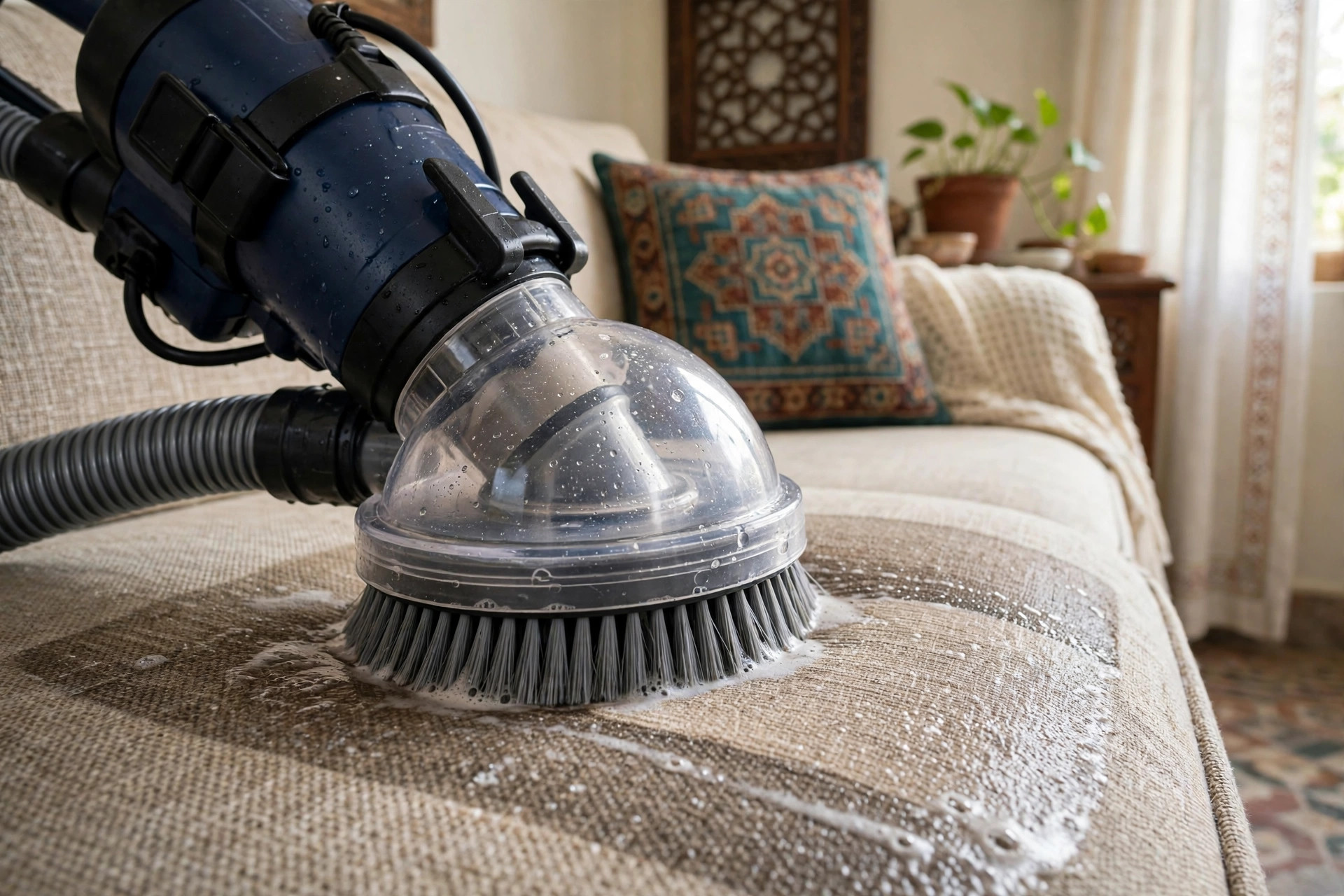
The deep clean itself uses low-moisture extraction, which lifts dust and dirt from the fabric without soaking it. The cleaning solution is worked into the fabric, and the dirt is then drawn out with the moisture, leaving the sofa cleaner through the weave rather than only on the surface. The arms, the backrest, and the seat are each cleaned in turn, and the cushions are cleaned on both sides where they can be removed.
Drying is part of the clean, not an afterthought. With low-moisture extraction, the sofa should not be left wet for long, and the room should be left with air moving through it so the fabric can dry evenly. Cushions should be left standing or spaced apart while they dry, rather than pressed back into place while still damp.
| Service | Price |
|---|---|
| Deep clean per seater | From Rs 600 per seater |
| Standard 5-seater set | Rs 2,500–4,000 |
A useful habit in between: vacuum upholstery weekly with a brush attachment, and treat any spill immediately. When booking a professional clean, ask whether they use low-moisture extraction — done correctly, sofas are dry the same evening.